Project
Hip Replacement Surgery Simulator
A bimanual VR simulator for total hip arthroplasty that renders the high forces of reaming and broaching with haptic feedback, so orthopedic residents can practice before they operate on patients.
01Overview
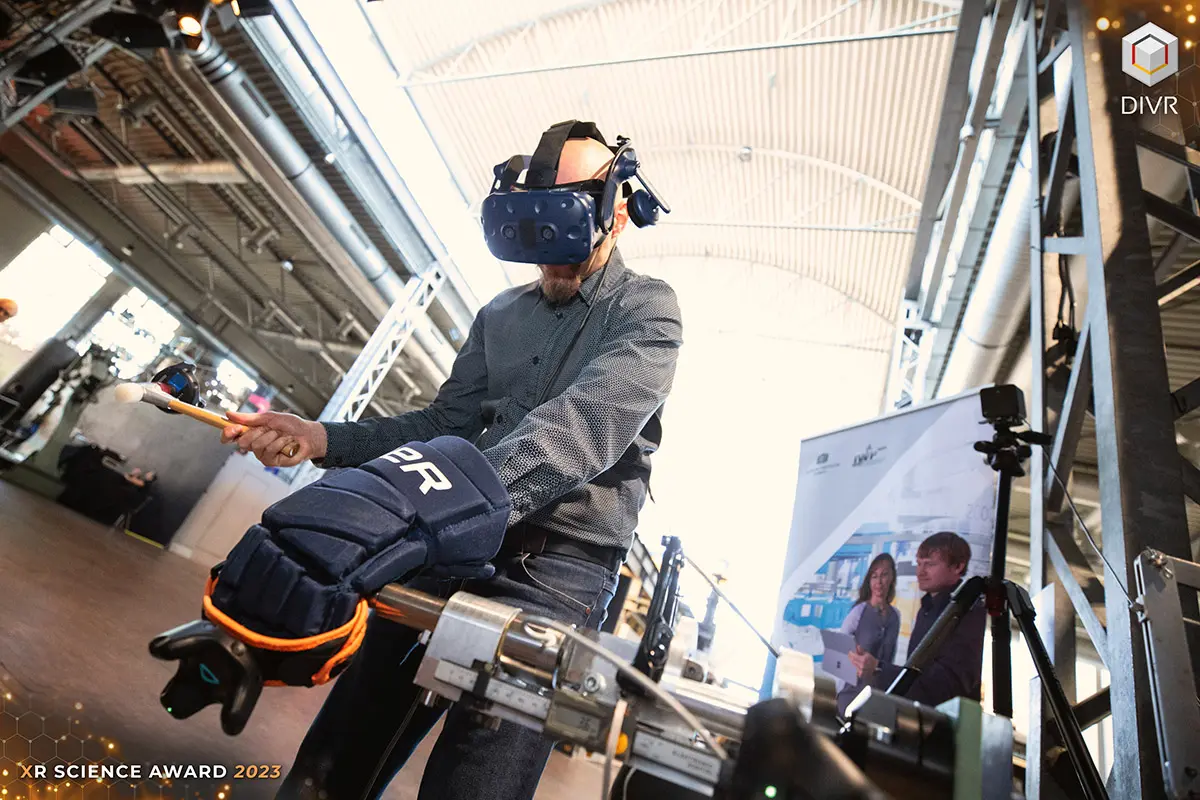
Total hip arthroplasty is one of the most successful orthopedic procedures, but the forces involved — the hammering, reaming, and broaching of bone — are difficult to practice safely. HIPS simulates the full procedure in virtual reality with two haptic devices, one for each hand, delivering realistic high-force feedback in real time.
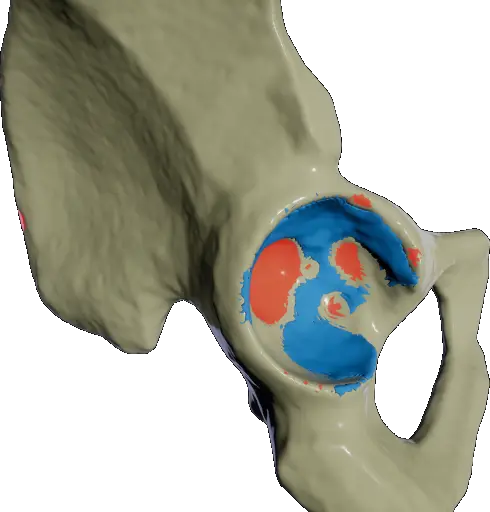
The simulator builds on a cadaver-based biomechanical model of acetabulum reaming, so the haptic sensation reflects measured, real-world tissue behavior. High-force haptic rendering that stays stable at bimanual interaction rates was a central research challenge.
Part of the CGVR research program at the University of Bremen: project page at Uni Bremen →
02The procedure, step by step
Since 2023 the simulator covers all five steps of hip arthroplasty, each with its own haptic challenge:
Cutting off the head of the femur
Osteotomy with a powered saw and high, constant cutting force.
Reaming the acetabulum
The most difficult step — surgeons rate it hardest to learn, because the right amount of force and duration can only be felt. Ream too far and you damage bone or, worse, major arteries.
Implanting the hip socket
Hammer impact with the patented force feedback device — impact force and bone contact must be felt precisely.
Rasping a cavity into the femur
Hammer-driven broaching until the rasp fits the medullary cavity.
Implanting the joint
Final hammer impact to seat the femoral implant firmly.
03Videos
04The technology
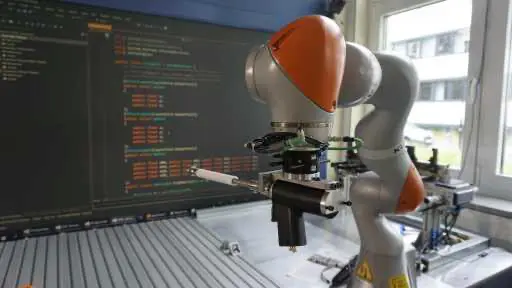
Up to 137 N of force
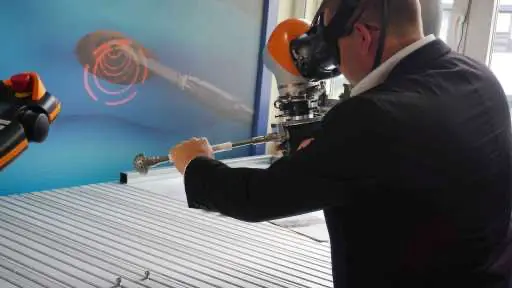
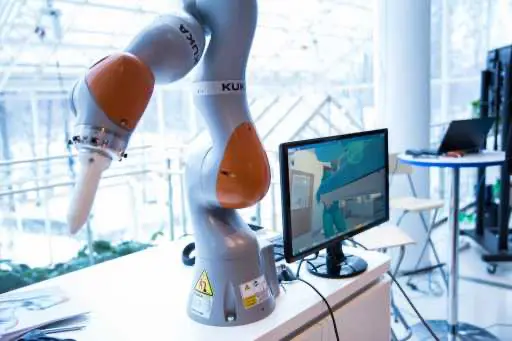
A KUKA LBR iiwa robot renders extremely hard contacts. Real surgeon tools mount directly to the end-effector.
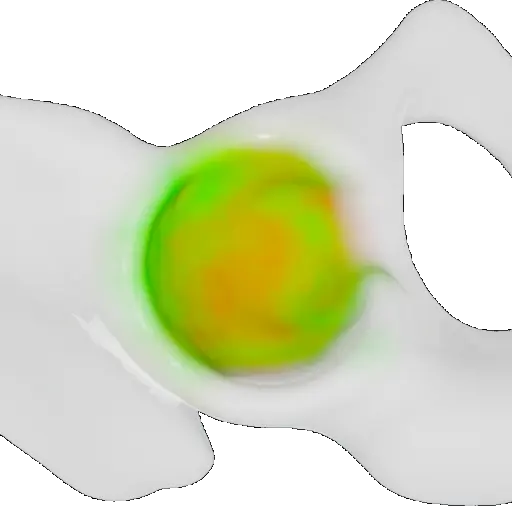
Cadaver-based model
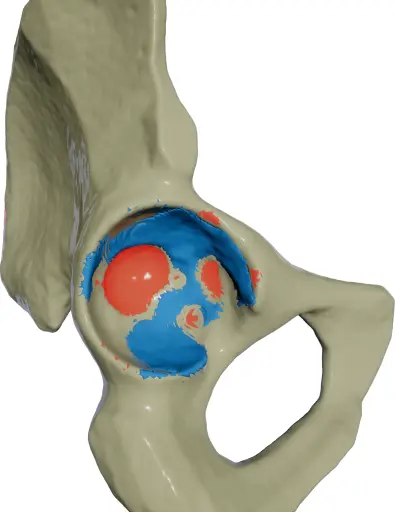
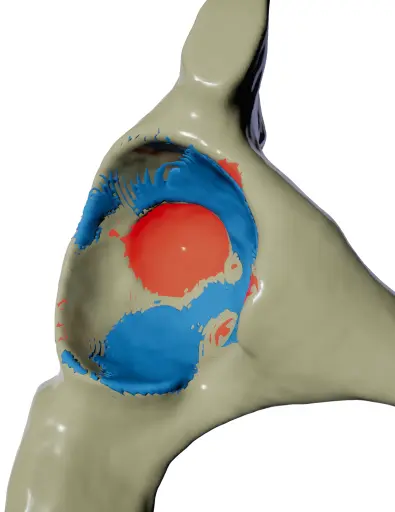
The haptic model reflects measured tissue behavior: density maps from cadaver acetabulums, red parts hard, green parts soft.
Inner sphere trees
A novel collision detection structure based on sphere packings keeps haptic rendering stable at high forces and interaction rates.
05Awards
DIVR-Award for best tech
Among 100+ participants from all over Europe.
2019DIVR-Award for best tech
Among about 50 participants.
2025IEEE VR Honorable Mention
For the HIPS journal paper presented at IEEE VR 2025.
2020Best Application Paper Award
EuroVR 2020, for the review of haptic rendering techniques.
06Gallery


07Key Results
- Over a dozen surgeons confirmed the realism of the haptic sensation, and nearly all who tried it recommend the simulator for training students and resident surgeons.
- Presented at IEEE VR 2025 with an Honorable Mention; journal version published in IEEE Transactions on Visualization and Computer Graphics (2025).
- The underlying haptic rendering methods were validated in a replication study of perceived realism for bimanual high-force tasks (Scientific Reports, 2023).
08Related Research
09Press & reports
- Interview "Hüftendoprothesen: OP virtuell und mit Gefühl trainieren", MEDICA online magazine, 2021
- "OP-Training dank VR", MDR, 2020
- Hip implant simulator for virtual surgery training, Tectales